

Every month, an ISO opens a processor statement and sees a number. That number is a residual. On its own, it looks small. But stacked across hundreds of merchants and years of renewals, it becomes one of the most valuable assets in the payments industry.
When you’re ready to sell your book, that stream of income will become a check. The amount you receive is directly related to the pricing of the book. And when it comes to ISO residual portfolio valuation, there is no guesswork involved. There are specific methods, intense diligence, and a market that values clean, sticky books.
This guide explains how payment M&A buyers value these portfolios. It looks at the primary methods, the variables that affect the multiple, and the strategies that sellers use to defend their number.
What Is an ISO Residual Portfolio?
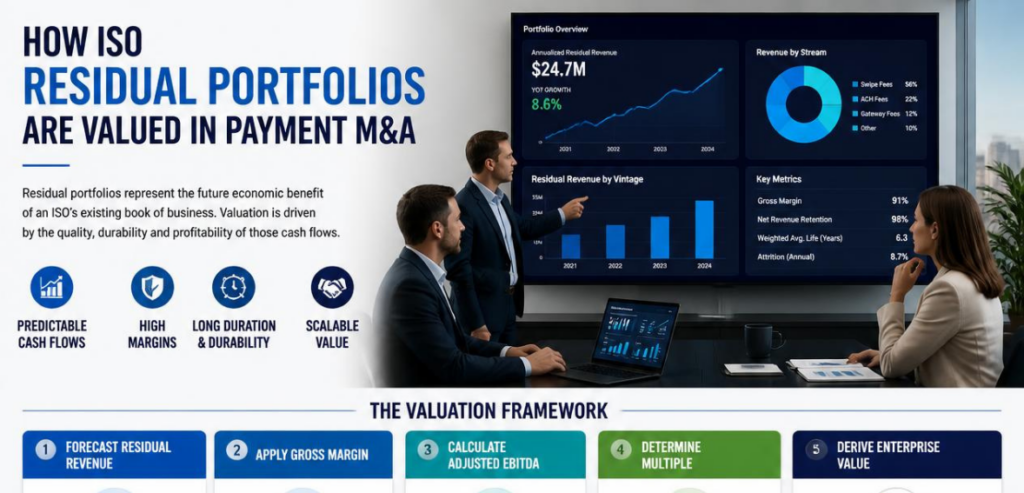
An Independent Sales Organization (ISO) acts as an intermediary for merchants seeking payment services. Payment processors partner with ISOs because merchants prefer the services an ISO offers. This partnership provides payment processors with several business advantages. While they lose direct engagement with merchants, they gain broader market reach through ISOs.
Residual portfolios are primarily the collection of contracted merchants serviced by an ISO. Each merchant serviced by an ISO contracts its payment processing with a third party. Monthly, ISOs earn the net residual after the payment processors take their fee.
Residual portfolios are valued primarily as portfolios of contracted merchants. The income from a merchant contracted by an ISO renews automatically, creating a residual income for ISOs, which therefore creates a merchant portfolio. For ISOs, the primary value of a residual portfolio is the income stream.
Why ISO Residual Portfolio Valuation Matters in Payment M&A
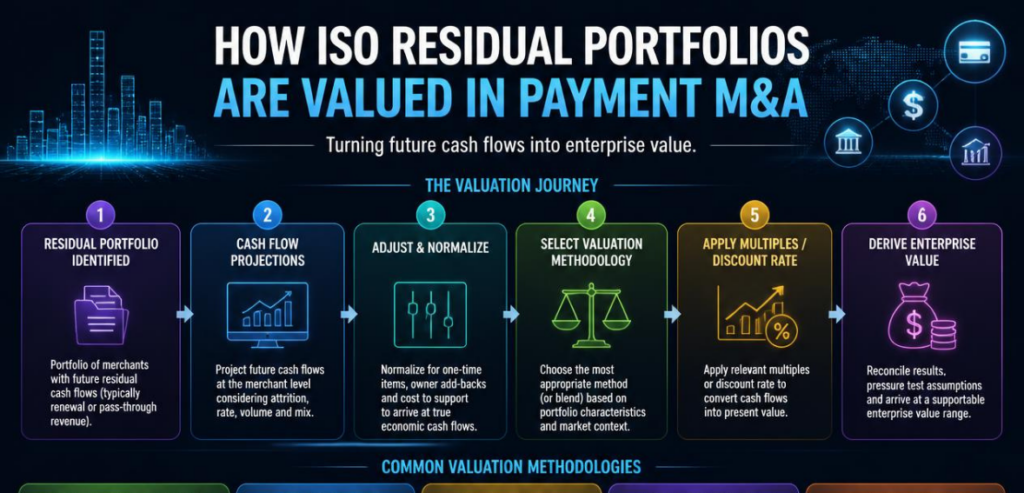
Payment M&A has been active for years. Strategics and private equity keep consolidating. Residual books are prime targets because the revenue is recurring and predictable.
For a seller, valuation is the difference between a fair exit and leaving money on the table. For a buyer, it sets the price of a cash flow they plan to hold for a decade. Both sides need the same yardstick.
Here is the key point. What you own decides how it gets valued. A pure residual stream is priced one way. A full ISO with a live sales engine is priced another. Getting that distinction right is step one.
The Core Methods Behind ISO Residual Portfolio Valuation
Two methods dominate. Sophisticated buyers run both and reconcile the results.
The Multiple of Monthly Residual
This outlines the headline method. A buyer takes your monthly net residual, applies a multiple, and the result is the offer.
Most residual portfolios sell in the 20x to 40x range of monthly net residuals in the current market. A clean book with low attrition would be valued in the higher range. A book with high attrition and risk concentration would be valued in the lower range.
There is a wide range of valuations, and this is indicative of the quality of the portfolio being valued. A premium portfolio with low single digit attrition and risk concentration in a diversified vertical would be valued in the mid-40x range. Thin documentation with high attrition could be in the high teens or low 20s. If a buyer were to value an entire ISO as opposed to just the book, the math would likely be based on EBITDA, where payment companies would be in the 8 to 18 times range, again depending on quality.
Discounted Cash Flow Analysis
The second method is discounted cash flow (DCF). This method estimates a future residual cash flow stream and converts that cash flow to present value.
DCF is an important method of valuation as both time and risk have value. Cash flow of $10,000 received two years from now is worth less than $10,000 today. The buyer will also incorporate a risk factor for the possibility that the cash flow stream may be lost and may also decrease in value.
The multiple is the value that is openly negotiated. The DCF is the valuation that the buyer performs in their mind to ensure that the multiple is justified. When both valuations are in alignment, the transaction is considered to be low risk.
The Factors That Move the Multiple Up or Down
No two residual streams are equal. A handful of factors decide where your book lands in the range.
Attrition Is the Biggest Lever
Attrition describes the inevitable decline in the volume of trade attributable to merchants over a given period. It is a dominant factor in the valuation of an ISO residual portfolio. Each point decrease in the annual attrition rate can have a significant and positive impact on the multiple.
Sensible buyers will not underwrite a single blended attrition rate. They will look for a cohort perspective. How do the accounts from 2020 differ from those in 2024? Not infrequently, accounts from a more recent year have a higher rate of attrition which later stabilizes. Differentiating the attrition rate by individual tenures signals a more advanced seller and positively impacts the multiple.
Merchant Concentration
Concentration measures how much of your residual comes from a few large merchants. If the top five accounts drive a third of the income, the book carries real risk. Lose one, and the stream drops fast.
A diversified book spreads that risk. Buyers pay more for it. A concentrated book gets discounted, no matter how big the headline residual looks.
Processor Terms and Portability
Portability poses a straightforward question. Do you own the merchant agreement, or just get the residual? If you own the merchant agreement, a buyer can re-route the merchant to a different processor. That kind of control is valuable and thus, worth a premium.
Direct relationships with premium processors help as well. Portfolios tied to major platforms and processors often attain higher valuations. Sub-ISO agreements tend to be valued lower due to the contract being a layer further away from the merchant.
How Buyers Run Diligence
Diligence is when a headline number stays the same or decreases. The buyer goes through the residual schedule during diligence. The buyer does a line-by-line reconciliation of the monthly statement to the bank deposits.
Problems arise with gaps. Not having all of the merchant agreements increases assignment risk. Not disclosing chargeback risk creates a trust issue. Last minute issues during diligence will result in a re-trade, which occurs when the buyer, after having agreed to the deal, reduces the price. These last-minute price reductions result in the loss of a significant amount of the deal value.
Having accurate data is the best way to protect the value of the transaction. The value of the underlying business will be maintained with reconciled reports, fully executed contracts, and accurate reporting of attrition.
Who Is Buying These Portfolios?

The buyer pool shapes the price. More qualified buyers at the table means more competition and a higher number. Three groups dominate payment M&A today.
Fiserv
Fiserv is a dominant global firm in payment technology. It’s one of the firms at the strategic end of the market. Firms like Fiserv obtain the necessary scale for pricing in the market with their extensive client relationships and partner networks.
Global Payments
Global Payments is another major strategic consolidator with a long history of large payment acquisitions. When strategics like Global Payments are active in the market, portfolio multiples across the industry tend to expand.
Private Equity Consolidators
Outside of the giants, competition for mid-sized books has intensified among sponsor-backed platforms. Companies like North American Bancard and other private equity-backed consolidators focus on lower-middle market independent sales organizations (ISOs). Their investment maintains strong demand and healthy multiples.
Deal Structures and Attrition Guarantees
The nature of the deal is as important as the multiple in valuing a company. Buying out a company is the simplest structure. At closing, a single check is cut. This structure is clean and helps sellers who are retiring as they will not be available to help the business post-closing.
An attrition guarantee has a different structure. In this case, the seller is guaranteeing that the residual attrition will not exceed a certain threshold (which is usually 10%). In this structure, the seller is offered a higher total payout, and the trade-off for the higher payout is service. The seller is obligated to continue servicing the merchants. Additionally, the guarantee should be on the residual dollars, as opposed to the number of merchants, to ensure that both parties are measuring the same.
How Sellers Maximize ISO Residual Portfolio Valuation
The best sellers build with an exit in mind from day one. They board quality merchants. They track attrition closely. They keep processor agreements transferable.
Competition is also an important consideration. A sale to one buyer in a quiet sale process is the lowest value sale. In the absence of competition, buyers will propose a lower-value offer. A tailored process that focuses on competition will attract strategic buyers who are willing to pay a premium. Therefore, many sellers rely on a specialist advisor to run the process and the uplift from the improved sale price covers the advisory fee.
Timing is also an important consideration. There is a window to sell when the large acquirers are in a buying frenzy, multiples widen, and there is an opportunity to sell. Trade associations like the Electronic Transactions Association monitor the deal activity and changes in the payments market that influence the multiples. Merchant portfolio valuation guides also assist sellers in determining the value of their portfolio prior to entering the market.
Conclusion
ISO residual portfolio valuation comes down to a simple idea. A residual book is a recurring income stream, and buyers price it like an annuity. The multiple of monthly residual sets the headline. The discounted cash flow confirms it. And the final number rises or falls on attrition, concentration, and contract quality.
Sellers who understand this hold the advantage. Clean data, low attrition, portable contracts, and a competitive process all push the price up. In a consolidating payments market, a well-run residual book is one of the most bankable assets you can own — and one of the most valuable to sell.
Frequently Asked Questions
What multiple do ISO residual portfolios sell for?
Most residual portfolios trade between 20x and 40x monthly net residuals. Premium, low-attrition books can reach the mid-40s. High-attrition or concentrated books often land in the high teens to low 20s. The exact number is set by the market, not a fixed formula.
What is the biggest factor in ISO residual portfolio valuation?
Attrition. It is the single largest driver of value. A lower attrition rate signals a sticky, durable income stream, and buyers pay more for it. Even a one-point improvement can raise the multiple.
How long does it take to sell a residual portfolio?
Most payment portfolio sales close within roughly 60 to 120 days. The timeline depends on diligence, data quality, and how many buyers compete. Clean statements and complete contracts speed things up.
What is an attrition guarantee?
It is a promise from the seller that residual attrition will stay below an agreed level after the sale. In return, the seller can earn a higher payout over time. It works best when the seller stays involved and keeps merchants happy.