

Revenue-based financing is becoming one of the most talked-about alternatives to traditional debt and equity funding for growing businesses. As founders look for flexible capital that aligns with their cash flow and long-term goals, revenue-based financing is stepping into the spotlight as a powerful option.
In this guide, we’ll break down exactly what revenue-based financing is, how it works, when it makes sense, and what you should watch out for before signing any agreement.
Throughout this article, we’ll use the term RBF frequently, because understanding how revenue-based financing fits into your funding strategy can significantly impact growth, cash flow, and ownership.
What Is Revenue-Based Financing?

Revenue-based financing (RBF) is a funding model where a business receives capital from an investor or financing company and agrees to pay it back as a fixed percentage of future revenue, rather than fixed monthly payments.
Instead of traditional principal and interest installments, your repayment adjusts with your sales. When your revenue is higher, you pay more; when revenue dips, your payments shrink accordingly.
In a typical RBF agreement, the financer gives you a lump sum (for example, $250,000). In exchange, you agree to repay that amount plus a pre-agreed multiple (say 1.3x or 1.5x), by sharing a set percentage of your gross revenue each month—often between 3% and 15%, depending on your margins and risk profile.
There is usually no set maturity date like a traditional loan; the relationship continues until you’ve fully repaid the agreed total.
Revenue-based financing sits somewhere between equity and debt. It’s similar to debt because you are obligated to repay a defined total amount, but it feels like equity in the sense that your investor’s returns are tied to your business performance.
Unlike equity, however, RBF does not require you to give up ownership or board seats. That combination—performance-based repayment without dilution—is what makes revenue-based financing so compelling for many growing businesses.
As access to online data, payment processors, and real-time analytics has improved, more funders can quickly underwrite deals based on recurring revenue, payment history, and customer retention.
That’s one reason revenue-based financing has grown rapidly in sectors like SaaS, ecommerce, subscription services, and digital businesses that can show predictable revenue streams.
Understanding RBF means understanding that it is not one-size-fits-all funding, but a flexible tool that can be tailored to your growth curve and risk appetite.
How Revenue-Based Financing Works in Practice
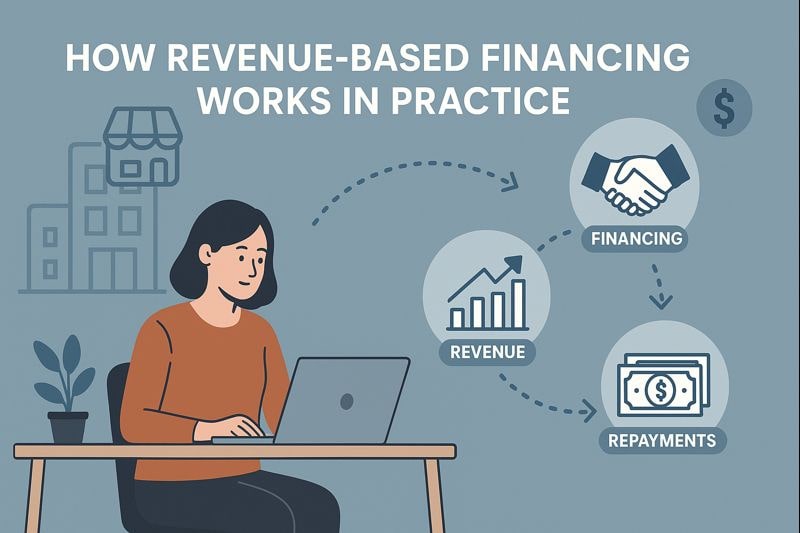
To really understand RBF, it helps to walk through the flow from application to final repayment. The process starts with a funding request, where you share recent financial data: monthly recurring revenue (MRR), annual recurring revenue (ARR), bank statements, payment processor data, and sometimes basic unit economics such as customer acquisition cost and churn.
Instead of focusing on hard collateral, the financing provider evaluates your ability to generate consistent revenue.
Once approved, the financer offers you a capital amount, a repayment multiple, and a revenue share percentage. For example, you might be offered $300,000 with a 1.4x cap, meaning you will repay $420,000 total.
The agreement might specify that you will share 8% of your monthly gross revenue until that $420,000 is fully repaid. This structure is the heart of revenue-based financing: payments rise and fall with your income, which can dramatically reduce pressure during slow months.
Each month, you report your revenue (or the provider pulls it automatically from your accounting system or payment processors). The agreed percentage is then calculated and automatically debited. So if you earn $200,000 this month, your payment at 8% would be $16,000. If next month’s revenue is only $120,000, your payment drops to $9,600.
With revenue-based financing, there’s typically no penalty for early repayment, because the investor expects to receive only the agreed total, not additional interest beyond the cap.
The time it takes to pay off RBF depends entirely on your growth. A fast-growing business might repay in 18–24 months, while a more stable company might take 3–5 years.
From a cash flow perspective, revenue-based financing can feel much more manageable than a fixed-payment loan, especially for businesses with seasonal or cyclical revenue.
However, the flexibility also means that if your revenue is consistently strong, you may end up repaying the total faster, making your effective annualized cost of capital higher than you initially realize.
Another key practical element of RBF is covenants and reporting obligations. Most providers require ongoing financial transparency, including monthly revenue reports, updated financial statements, and sometimes minimum performance thresholds.
Knowing how revenue-based financing agreements work in day-to-day operations will help you avoid surprises and negotiate terms that align with your growth projections.
Key Features and Terms in Revenue-Based Financing Agreements

Every revenue-based financing deal comes with a handful of core elements you should understand before signing. First is the financing amount—the total lump sum you receive upfront.
This is typically tied to your current revenue level or recurring revenue base, often ranging from a few months to about a year’s worth of revenue, depending on your risk profile and provider.
Second is the repayment multiple or cap, usually expressed as a factor like 1.2x, 1.3x, or 1.5x. If you receive $200,000 at a 1.4x multiple, your total repayment obligation is $280,000.
This cap functions similarly to the total interest cost in a loan, but it’s expressed as a fixed multiple instead of an interest rate. When evaluating revenue-based financing, understanding this multiple is critical to comparing it with other funding options.
Third is the revenue share percentage, often between 3% and 15% of your monthly gross revenue. The higher the percentage, the faster you repay the cap, but the more strain you put on short-term cash flow.
The lower the percentage, the longer repayment will take, and the higher your effective annual cost may be if the cap remains the same. Choosing a realistic revenue share percentage is one of the most important steps in structuring revenue-based financing.
Fourth are covenants and restrictions. While RBF is usually more flexible than traditional bank loans, you may still encounter covenants tied to minimum revenue, information rights, or limitations on taking additional senior debt.
Some providers may also require a security interest in certain assets or a personal guarantee, though many modern revenue-based financing platforms rely primarily on revenue data and do not demand personal guarantees.
Finally, pay attention to fees. Beyond the core RBF multiple, there may be origination fees, servicing fees, or fees for early refinancing.
Ask for a clear breakdown of the all-in cost of capital in both dollar terms and estimated annualized terms based on your projected revenue growth. The clearer you are on these fundamental features and terms, the better positioned you are to use RBF strategically rather than reactively.
Revenue-Based Financing vs Traditional Bank Loans
When you compare revenue-based financing to traditional bank loans, the differences become clear. A bank loan typically carries a fixed interest rate, fixed monthly payments, strict collateral requirements, and sometimes personal guarantees from the founders.
If your revenue dips, your loan payment does not. That mismatch creates cash flow stress and can push a business into default even if it’s fundamentally healthy but experiencing temporary volatility.
RBF, by contrast, aligns repayment with sales performance. If your revenue drops, your payment drops in real time because you owe only a set percentage, not a rigid dollar amount each month. That’s a major benefit for businesses with seasonal or unpredictable revenue.
From a qualification standpoint, banks often prioritize collateral, long operating histories, and strong credit scores. Many younger or asset-light businesses—such as SaaS companies, ecommerce brands, and digital agencies—struggle to qualify.
Revenue-based financing providers focus more on real-time revenue, payment processing data, customer retention, and margins. If you can show strong recurring revenue or consistent monthly revenue, you may qualify for revenue-based financing even when a bank says no.
On the flip side, bank loans, especially from community or regional banks, can offer much lower nominal interest rates than revenue-based financing multiples, particularly if you qualify for government-backed loan programs.
Another difference is flexibility around use of funds. RBF is often used for growth investments—marketing, hiring, inventory, product development—while bank loans may be more conservative, especially with lender-imposed restrictions.
Banks may have longer approval processes and more intensive underwriting. RBF platforms often provide much faster approval and funding due to automated data access and algorithms.
Ultimately, the choice between a bank loan and revenue-based financing depends on your priorities. If you value lower nominal cost and qualify for a traditional loan, a bank may be attractive.
If you prioritize flexible payments and faster access to growth capital without pledging heavy collateral, revenue-based financing may be the better fit.
Revenue-Based Financing vs Equity and Venture Capital
Founders often compare revenue-based financing not only to loans but also to equity and venture capital. Equity funding involves selling a portion of your company in exchange for capital.
This dilutes your ownership, but you do not have a contractual obligation to repay the funds. Investors earn returns if your company grows significantly in value and eventually exits through a sale or public offering.
RBF is non-dilutive. You retain full ownership and control, while the financer receives contractual repayment out of revenue up to an agreed cap.
For founders who want to preserve equity for future rounds or maintain long-term control, revenue-based financing is especially appealing. It lets you access growth capital without permanently reducing your ownership stake.
Equity investors, especially venture capitalists, often push for hyper-growth and large exit outcomes. Their model requires a small number of big “wins.” That can drive strategy in directions that may not align with your risk tolerance or lifestyle goals.
Revenue-based financing investors, by contrast, care deeply about steady revenue growth and consistent performance, not necessarily billion-dollar exits. They want you to succeed, but their returns are tied to your revenue instead of a future sale.
However, revenue-based financing is not a perfect substitute for equity. Equity can provide large capital injections for high-risk, long-horizon projects such as deep technology, biotechnology, or platforms that take years before generating meaningful revenue.
RBF is better suited to businesses that already have or are close to achieving repeatable revenue. If your company is still pre-revenue or highly experimental, equity may be more realistic.
Some companies even blend both: they raise a smaller equity round for long-term product development, then layer in revenue-based financing to fuel working capital, marketing, or sales as revenue ramps up.
Thinking about revenue-based financing as part of a balanced capital stack, rather than a binary choice, will help you design a funding approach that matches your roadmap and risk-adjusted goals.
Which Businesses Are Best Suited for Revenue-Based Financing?
Revenue-based financing is not for every business, but it can be an excellent fit for certain models and industries. The ideal candidate has relatively consistent and predictable revenue, decent gross margins, and clear opportunities to reinvest capital for growth.
Subscription-based businesses—such as SaaS companies, membership platforms, and recurring service providers—are classic fits. Their recurring revenue creates reliable cash flow, making RBF easier to underwrite and repay.
Ecommerce brands, particularly those with strong online sales histories and loyal customer bases, are also well-suited for revenue-based financing. They can often deploy capital quickly into inventory and performance marketing, then use increased sales to accelerate repayment.
Agencies, consultancies, and digital service firms with stable client contracts and retainer models can leverage revenue-based financing to expand teams, launch new offerings, or enter new markets.
On the other hand, businesses with highly volatile, one-off revenue, razor-thin margins, or extremely long sales cycles may struggle with revenue-based financing, because the revenue share could consume too much of their limited cash.
Pre-revenue startups, early-stage ideas, and highly speculative ventures usually aren’t ready for revenue-based financing until they establish real traction. Understanding your own revenue profile and margin structure is essential before pursuing revenue-based financing.
Another factor is data transparency. Businesses that track revenue in cloud-based accounting systems, payment processors, or subscription management tools can more easily integrate with revenue-based financing platforms.
That integration allows automatic revenue verification and repayment, which lowers underwriting friction. As digital infrastructure improves across more industries, the universe of businesses eligible for revenue-based financing continues to expand.
If your business is in a growth phase, has proven product-market fit, and can clearly connect each dollar of new funding to revenue-generating activities, revenue-based financing can be a powerful catalyst.
If your revenue is still inconsistent, your margins are tight, or your data is disorganized, you may want to shore up fundamentals before taking on this type of obligation.
Advantages of Revenue-Based Financing for Founders
One of the biggest advantages of revenue-based financing is its alignment with your business performance. Instead of facing a fixed loan payment every month regardless of sales, your repayment adjusts with revenue.
This can dramatically reduce stress during slower periods, seasons, or macroeconomic downturns. It’s a more forgiving structure than traditional debt, while still maintaining clarity around total repayment.
Another major benefit is the non-dilutive nature of revenue-based financing. You keep your equity, your cap table remains cleaner, and you avoid giving up board seats or voting control.
For founders who have already raised equity at lower valuations, revenue-based financing can help avoid further dilution before a major milestone that could boost valuation.
Speed is another advantage. Many revenue-based financing providers offer fast underwriting because they rely on automated access to real-time revenue, payment, and banking data.
Rather than months of negotiation, you might receive an offer in days or even hours once your data is connected and verified. This speed matters when you need to seize time-sensitive growth opportunities, like scaling advertising campaigns or purchasing discounted inventory.
Revenue-based financing can also be more flexible in terms of use of funds. As long as your revenue continues to support repayment, providers are often comfortable with a range of growth-oriented uses: marketing, hiring key staff, expanding operations, or buying equipment.
Some investors also provide value beyond money, such as analytics dashboards, benchmarking, or introductions to partners.
Finally, revenue-based financing can enhance your negotiating power in future equity rounds. By using non-dilutive capital to reach key milestones—like profitability, higher ARR, or major partnerships—you may be able to raise equity later at a stronger valuation or with better terms.
Thinking of revenue-based financing as a bridge to better outcomes, rather than just a cash infusion, can help you leverage it strategically.
Risks and Drawbacks of Revenue-Based Financing
Despite its advantages, revenue-based financing carries trade-offs and risks that you must understand. The most frequently cited drawback is cost.
Compared with bank loans, the effective annualized cost of capital for revenue-based financing can be significantly higher, especially if your company grows quickly and repays the cap in a shorter period.
A 1.5x multiple might feel comfortable at first, but if you repay in 18 months, the implied annualized rate can be steep.
Another risk is the impact on cash flow during high-revenue periods. Because payments are tied to a percentage of revenue, a strong month can come with a correspondingly large repayment.
This may reduce your ability to reinvest all of that extra cash into growth. You need to carefully model how different revenue scenarios will interact with your revenue-based financing obligations.
There is also the risk of over-leveraging. Because revenue-based financing is relatively accessible for proven businesses, some founders may layer on multiple facilities from different providers.
While stacking can increase available capital, it can also create a heavy combined revenue share that eats into margins and constrains future flexibility. Monitoring your total obligations and maintaining ample buffer room is essential.
Documentation risk is another factor. Not all revenue-based financing agreements are created equal. Some may include restrictive covenants, broad security interests, or fees and penalties that are not obvious at first glance.
If you don’t fully understand the terms, you might end up limiting your ability to raise additional capital or restructure your obligations later.
Finally, there’s the psychological and strategic risk of focusing too heavily on short-term revenue to satisfy revenue-based financing obligations. If you over-prioritize short-term revenue over long-term product quality, R&D, or brand building, you might undermine your company’s future potential.
The key is to balance revenue-based financing commitments with a clear long-term strategy, ensuring that the capital accelerates sustainable growth rather than pushing you into short-termism.
How to Evaluate Whether Revenue-Based Financing Is Right for Your Business
Deciding whether revenue-based financing is right for you starts with a clear look at your numbers. First, analyze your historical revenue volatility.
If your monthly revenue is relatively stable or trending upward with manageable swings, revenue-based financing may fit well. If your revenue is highly unpredictable, relying on a revenue share could create stress during long downturns.
Next, examine your gross margins and operating margins. Revenue-based financing works best for businesses with comfortable margins, because the revenue share comes off the top line.
If you already operate on thin margins, an additional 5–10% of revenue going to repayments could be difficult to sustain. Build a detailed forecast that layers in different revenue growth scenarios and your expected revenue-based financing payments.
You should also consider your growth opportunities. Revenue-based financing shines when you can deploy capital into predictable, repeatable growth activities that generate returns greater than the cost of capital.
For example, if you know that for every $1 you spend on advertising you get $3–$5 in gross profit, using revenue-based financing to scale that engine can make sense. If your growth opportunities are less clear or more experimental, equity might be safer.
Compare revenue-based financing to your realistic alternatives. If you qualify for low-cost bank loans or have access to strategic equity investors who bring more than money to the table, weigh their benefits and costs carefully.
On the other hand, if banks have turned you down and you wish to avoid dilution, revenue-based financing may strongly stand out.
Finally, evaluate your risk tolerance and control preferences. If maintaining ownership and independence is important, the non-dilutive nature of revenue-based financing may be compelling.
If you’re comfortable with dilution in exchange for lower pressure on near-term cash flow and debt obligations, equity may be more attractive. Asking these questions honestly will help you determine whether revenue-based financing is a tactical tool or a core part of your long-term capital strategy.
Typical Costs and Pricing Models in Revenue-Based Financing
Understanding the cost structure of revenue-based financing is crucial for making smart decisions. Unlike traditional loans that advertise an annual interest rate, revenue-based financing typically uses a factor rate or repayment multiple.
For instance, if you receive $200,000 with a 1.3x factor, you will repay $260,000 in total. The time it takes to repay that cap, driven by your revenue and the agreed revenue share, determines your effective annualized cost.
To evaluate the cost of revenue-based financing, you should calculate the expected internal rate of return (IRR) or annual percentage rate (APR)-like estimate.
While many providers do not quote an APR directly, you can estimate it using your projected revenue growth and expected repayment timeline. If you anticipate repaying in two years, that 1.3x multiple might be roughly comparable to a specific annual rate; if you repay in one year, the implied rate is significantly higher.
Some revenue-based financing providers also charge origination fees, usually expressed as a percentage of the funding amount and deducted upfront. Others may add modest monthly servicing fees.
Make sure you include all fees—not just the multiple—when calculating your total and effective costs. Also check whether there are any early payoff discounts or refinancing options if your performance exceeds expectations.
Different providers may use slightly different revenue-based financing structures. Some will cap repayment at a multiple and maintain a fixed revenue share until it’s fully paid. Others may gradually reduce the revenue share as you approach full repayment.
Some newer platforms blend revenue-based financing with other forms, such as a base fee plus a performance-based upside. Understanding these nuances will help you compare offers on an apples-to-apples basis.
As the market matures, competition among revenue-based financing providers is putting downward pressure on costs and encouraging greater transparency. Still, revenue-based financing will usually remain more expensive than secured bank debt but less dilutive than equity.
Modeling your expected repayment under a conservative, realistic, and optimistic scenario will show whether the expected returns from deploying the capital justify the cost.
The Application and Underwriting Process for Revenue-Based Financing
The application process for revenue-based financing is generally more streamlined than traditional business lending.
Instead of lengthy paper applications, many platforms allow you to apply online in minutes by connecting your accounting software, bank accounts, subscription billing tools, or payment processors. This connectivity gives the provider instant access to your revenue patterns, retention metrics, and cash flow.
Underwriting for revenue-based financing centers around a few key metrics: monthly recurring revenue or average monthly revenue, gross margins, customer retention, and growth trends.
Providers may also look at your churn rate, customer lifetime value (LTV), and customer acquisition cost (CAC), especially in SaaS and subscription businesses. This data-driven approach allows them to quickly assess how much capital your revenue can reasonably support.
During the underwriting process, a revenue-based financing provider will determine your eligible funding amount, the repayment multiple, and the revenue share percentage. They may run scenario analyses to see how different revenue levels affect repayment time.
They will also assess your historical financial discipline—whether you manage expenses prudently, maintain good cash reserves, and avoid excessive existing debt.
You’ll typically be asked to provide basic corporate documents, such as incorporation papers, cap tables, and any existing debt agreements. Some providers may run a credit check on the business or founders, though credit scores are often less central than revenue performance.
Once underwriting is complete, you receive a term sheet outlining key revenue-based financing terms. Review this carefully and consider consulting a legal or financial advisor before signing.
Funding can often be disbursed quickly after acceptance, sometimes within a few days. The provider will establish automated payment mechanisms, either by direct debit or by integrating with your payment rails.
From that point on, the revenue-based financing provider will regularly monitor your revenue and adjust payments as agreed. Having a clear understanding of this process upfront ensures you know what data will be accessed, how decisions are made, and how quickly you can expect capital.
Legal and Regulatory Considerations in Revenue-Based Financing
While revenue-based financing is more flexible than traditional lending, it still involves legal and regulatory considerations you shouldn’t ignore. Depending on how the agreement is structured, it may be treated as a loan, a sale of future receivables, or a hybrid contract.
The legal classification can affect everything from how it appears on your balance sheet to which consumer or commercial lending laws may apply to the provider.
Most revenue-based financing agreements are commercial in nature, meaning they finance business activities rather than personal consumption. As a result, they are generally not subject to the same consumer protection laws that apply to personal loans or credit cards.
However, several jurisdictions have begun introducing disclosure requirements for commercial financing, including revenue-based financing and merchant cash advances. These rules aim to ensure that businesses receive clear, standardized information about costs and terms.
From your perspective, the most important legal considerations are the specific rights and obligations listed in the contract. Look for clauses related to default, acceleration, security interests, and dispute resolution.
A revenue-based financing agreement may grant the provider a security interest in your receivables or other assets, which could affect your ability to secure future loans. It may also include cross-default clauses that link this agreement to other debts.
You should also be aware of any reporting obligations and audit rights. Most revenue-based financing providers will reserve the right to verify your revenues, either through regular data connections or periodic reviews.
Make sure you’re comfortable with the scope of access granted and that it aligns with your privacy and security policies. If the contract includes personal guarantees, understand exactly what personal liability you are taking on.
As the revenue-based financing ecosystem matures, you can expect regulators to continue focusing on fair disclosure, clarity of terms, and prevention of deceptive practices.
Staying informed about these developments and working with reputable providers will help ensure that your revenue-based financing arrangements are both legally sound and aligned with best practices.
Future Trends and the Evolution of Revenue-Based Financing
The future of revenue-based financing is closely tied to the broader evolution of fintech, embedded finance, and data-driven underwriting. As more business activity moves online and more financial data becomes accessible via APIs, providers can underwrite revenue-based financing with increasing precision.
This will likely expand revenue-based financing beyond early adopters like SaaS and ecommerce into more traditional sectors that now have better digital footprints.
One emerging trend is embedded revenue-based financing, where capital is offered directly within the software tools businesses use every day—such as ecommerce platforms, payment processors, and billing systems.
Instead of seeking an external lender, a business might be offered revenue-based financing right inside its dashboard based on real-time performance. This frictionless distribution model could make revenue-based financing far more accessible to small and midsize businesses.
Another trend is more sophisticated risk pricing. Advanced analytics, machine learning, and alternative data sources will allow revenue-based financing providers to refine their pricing, potentially reducing costs for lower-risk businesses and tailoring terms more precisely.
We may see dynamic revenue share percentages that adjust based on performance metrics, or hybrid models that combine base fees with performance-based components.
Revenue-based financing is also likely to play a larger role in blended capital stacks, alongside traditional loans, lines of credit, and equity.
As founders become more sophisticated in capital strategy, they’ll intentionally mix revenue-based financing for growth working capital with equity for long-term innovation and secured loans for assets. This holistic approach can optimize cost of capital while maintaining flexibility.
Regulatory and industry standards will continue to develop. Expect increased transparency requirements around cost disclosures and standardized metrics that make it easier to compare revenue-based financing offers. Industry associations may introduce best-practice guidelines for contract terms, data access, and dispute resolution.
In the long term, revenue-based financing is poised to become a mainstream option for growth-stage businesses that can demonstrate durable revenue. As capital markets evolve, understanding revenue-based financing and how it fits into your funding toolkit will be an increasingly important skill for founders, CFOs, and finance leaders.
Practical Tips for Negotiating and Managing Revenue-Based Financing
If you decide to pursue revenue-based financing, negotiation and ongoing management are critical. Start by clearly identifying your goals: how much capital you truly need, how you will deploy it, and what a realistic repayment timeline looks like.
Avoid the temptation to take the maximum amount offered if it would put undue pressure on cash flow under conservative revenue scenarios.
When negotiating terms, focus on the repayment multiple, revenue share percentage, and any fees. Ask the provider to walk through example scenarios using your actual revenue history and forecast.
Request a clear breakdown of the estimated effective annual cost based on different repayment timeframes. Don’t be afraid to negotiate the factor rate or fees, especially if you have multiple offers.
Pay attention to covenants and restrictions. Clarify whether you can take on additional debt, raise equity, or refinance without triggering penalties or default. Ensure that reporting requirements are reasonable and compatible with your existing systems.
If the provider requests a security interest or personal guarantee, consider whether that aligns with your risk tolerance and long-term plans.
Once the agreement is in place, treat revenue-based financing as an ongoing relationship rather than a one-time transaction. Monitor your revenue, repayments, and cash flow impact monthly. Update your forecast regularly and compare actual performance with your initial plan.
If you’re growing faster than expected, consider whether early repayment, refinancing, or rebalancing your capital stack makes sense. If growth slows, maintain open communication with your provider.
Finally, always frame revenue-based financing in terms of return on investment. Track the impact of the funded initiatives on revenue, profit, and long-term value.
If the capital is consistently generating returns above the effective cost of revenue-based financing, you’re using it well. If not, you may need to adjust your strategy or scale back your reliance on this form of funding.
FAQs
Q1. Is revenue-based financing considered debt or equity?
Answer: Revenue-based financing has characteristics of both debt and equity but is usually treated more like debt. You receive capital up front and commit to repaying a fixed multiple through a share of revenue. Unlike equity, revenue-based financing does not involve issuing shares or giving up ownership.
However, the variable payment structure and alignment with performance make it feel more flexible than a traditional loan. On your balance sheet, revenue-based financing is typically recorded as a liability, but accounting treatment can vary, so consult your accountant or financial advisor for specifics.
Q2. How is revenue-based financing different from a merchant cash advance?
Answer: Both revenue-based financing and merchant cash advances involve repaying a lump sum through a share of future revenue. However, merchant cash advances traditionally target very short-term funding needs, often with daily or weekly deductions and higher effective costs.
They are commonly based on card-processing volume from a payment processor. Revenue-based financing usually has longer horizons, monthly payments, and is designed as a growth-oriented funding tool rather than emergency cash.
Revenue-based financing providers often take a more holistic view of your business’s finances and growth prospects, rather than just card sales.
Q3. How much revenue do I need to qualify for revenue-based financing?
Answer: Qualifying thresholds vary by provider, but many revenue-based financing platforms look for a consistent minimum monthly revenue, often in the tens of thousands of dollars, and at least several months of operating history.
SaaS and subscription businesses may need a certain level of recurring revenue (MRR or ARR), while ecommerce brands may need steady monthly sales and repeat customers. If your revenue is very early or irregular, you may not yet qualify for revenue-based financing and might need to focus on building more predictable revenue first.
Q4. Does revenue-based financing affect my credit score?
Answer: Because revenue-based financing is typically commercial in nature and issued to a business entity, it may not directly impact your personal credit score, especially if there is no personal guarantee.
However, some providers may run a personal credit check during underwriting, and some agreements may include personal guarantees that could influence your personal credit if the business defaults.
Business credit bureaus may also track your payment behavior. Always ask the provider how they report payment history and whether they require any personal credit involvement.
Q5. Can I use revenue-based financing alongside bank loans or equity?
Answer: Yes. Many businesses use revenue-based financing as one component of a broader capital strategy that includes bank loans, lines of credit, and equity investment.
For example, you might use a bank loan for equipment purchases, equity for long-term product development, and revenue-based financing for marketing and working capital tied directly to revenue growth.
When combining funding sources, make sure that covenants and security interests do not conflict and that your total obligations remain manageable.
Q6. What happens if my revenue drops significantly?
Answer: If your revenue drops, your payments under a typical revenue-based financing agreement also drop in proportion to your revenue share percentage. This provides built-in downside protection compared to fixed-payment debt.
However, if the decline is severe or prolonged, the provider may review your situation more closely. Some contracts may contain covenants that, if breached, allow the provider to declare default or renegotiate terms.
It’s important to maintain open communication and to understand your contractual obligations so you can respond proactively if your revenue weakens.
Q7. How fast can I get funding through revenue-based financing?
Answer: Speed varies by provider, but one of the attractions of revenue-based financing is the relatively quick timeline. Once you connect your financial and revenue data, many platforms can evaluate your eligibility and make an offer in a short period of time.
After you accept the terms and complete any required documentation, funds are often disbursed within a few business days. The exact timing will depend on the provider’s processes, your readiness with documentation, and any legal considerations.
Conclusion
Revenue-based financing has emerged as a powerful, flexible funding option for growing businesses that want to align repayment with revenue, avoid dilution, and access capital quickly. By tying payments directly to sales, revenue-based financing can ease cash flow pressure during slow periods while still providing the growth capital needed to scale.
At the same time, revenue-based financing is not without trade-offs. The cost can be higher than traditional loans, especially for fast-growing businesses, and the revenue share can bite into margins during strong months.
The key to using revenue-based financing wisely is understanding your revenue stability, margins, growth opportunities, and alternative funding options.
If your business has predictable revenue, healthy margins, and a clear plan for deploying capital into high-return growth activities, revenue-based financing may be a powerful addition to your capital toolkit.
If you’re still pre-revenue, highly volatile, or unsure where to best invest new funds, you may want to focus first on strengthening your fundamentals or exploring other forms of financing.
Ultimately, understanding revenue-based financing—its structure, advantages, risks, and future evolution—allows you to make informed decisions about when and how to use it.
By approaching revenue-based financing strategically, you can fuel sustainable growth, preserve ownership, and build a more resilient financial foundation for your business.