

Merchant cash advances are one of the most misunderstood types of small business financing. They are marketed as fast, flexible funding, but the way a merchant cash advance works is very different from a traditional business loan.
Understanding exactly how merchant cash advances work, how much they really cost, and when they might make sense can help you avoid expensive mistakes and choose the right type of funding for your business.
In this guide, we’ll walk step by step through what a merchant cash advance is, how repayment works, how the fees are structured, the pros and cons, legal and regulatory issues, and how merchant cash advances may evolve in the future.
We’ll also cover alternatives and answer common questions so you can compare a merchant cash advance with other financing options in a clear and practical way.
What Is a Merchant Cash Advance?

A merchant cash advance is a financing arrangement where a provider gives your business a lump sum of capital in exchange for a fixed portion of your future sales.
Instead of paying a traditional interest rate with a fixed monthly payment, you agree to send a percentage of your daily or weekly revenue (often from credit and debit card sales or bank deposits) until a predetermined “payback amount” has been collected.
With a merchant cash advance, the provider is technically purchasing a share of your future receivables, not issuing a loan in the traditional sense. That is why many merchant cash advance agreements are structured as “receivables purchase agreements” rather than loan contracts.
The provider charges a factor rate instead of a stated annual percentage rate (APR). For example, if you receive $50,000 at a factor rate of 1.35, your total payback amount is $67,500, regardless of how quickly you pay it off.
The appeal of a merchant cash advance is speed and flexibility. Many providers can approve an application in hours and fund within a day or two, often with lighter credit requirements than banks.
Instead of strict collateral requirements and lengthy underwriting, merchant cash advance companies lean heavily on your recent sales history and bank statements. This makes a merchant cash advance attractive to businesses that have strong revenue but weaker credit or limited time in business.
However, because the risk is higher and the repayment structure is different, the effective cost of a merchant cash advance can be much higher than traditional funding.
When you translate a factor rate into an APR, it can often reach the high double digits or even triple digits, depending on the terms and how quickly the advance is repaid. That’s why understanding how a merchant cash advance works is essential before signing any agreement.
Merchant Cash Advance vs. Traditional Business Loan
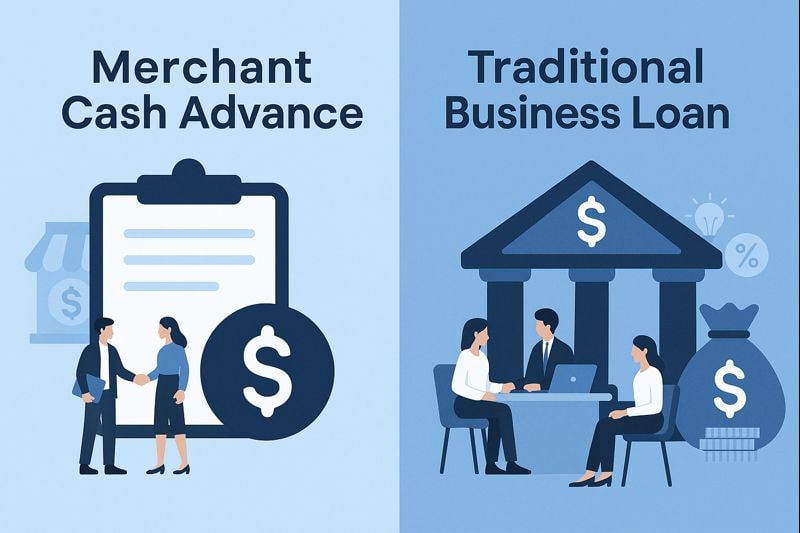
Although a merchant cash advance can feel similar to a loan—because you get a lump sum of money up front—the two products operate very differently. Understanding the differences between a merchant cash advance and a business loan can help you decide which option fits your situation.
A traditional business loan usually involves borrowing a fixed principal amount with a set interest rate, a clear repayment schedule, and a defined term such as three or five years.
You make fixed monthly payments that include principal and interest, and those payments do not change based on your sales. The lender earns interest over time, and you can often pay off the loan early with little or no penalty, depending on the agreement.
By contrast, a merchant cash advance is not amortized over a long term. You agree to repay a fixed payback amount that is calculated by multiplying the advance amount by the factor rate.
Instead of fixed monthly payments, the provider collects a percentage—called a holdback or retrieval rate—from your daily card sales or weekly bank deposits until the full payback amount is collected. If your sales are strong, you pay off the merchant cash advance faster; if your sales slow down, you pay it off more slowly.
Another key difference is how costs are disclosed. Business loans are required to disclose interest rate and APR clearly, along with fees. Merchant cash advance providers have historically disclosed only factor rates and total payback amounts.
Recently, several states have adopted commercial financing disclosure laws that require merchant cash advance companies to provide APR-like cost estimates and clearer terms, but disclosure rules still vary by jurisdiction. This regulatory trend is likely to continue as regulators focus on high-cost small business financing.
Finally, a merchant cash advance may be easier to qualify for if your credit score is lower or your time in business is shorter, because approval is heavily based on recent revenue.
Traditional loans often require more documentation, stronger credit history, and sometimes collateral. That flexibility is a big reason merchant cash advances remain popular, even though they are often more expensive than loans or lines of credit.
Key Terms: Factor Rate, Holdback, and Payback Amount
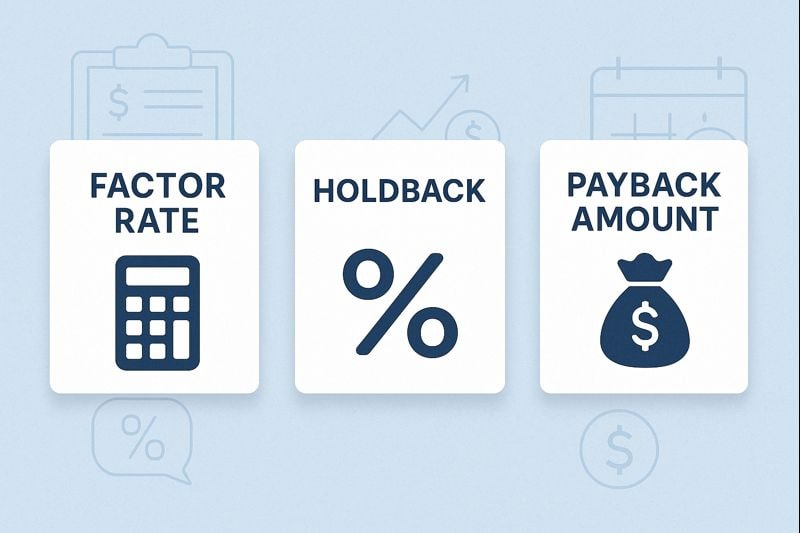
To really understand how a merchant cash advance works, you need to get comfortable with a few key terms that are used throughout merchant cash advance agreements. These terms determine the real cost and how repayments will affect your cash flow.
The factor rate is the multiplier that determines your total payback amount. It is usually expressed as a number like 1.25, 1.35, or 1.50 instead of as a percentage rate. To calculate the total you will repay, you multiply the amount of the merchant cash advance by the factor rate.
For example, a $40,000 advance at a factor rate of 1.30 means you will repay $52,000 in total. This includes the original advance plus the provider’s profit.
The holdback rate (also called the retrieval rate or split percentage) is the portion of your daily or weekly sales that will be deducted and sent to the provider. Holdback rates commonly range from about 5% to 25%, depending on your average sales volume, the size of the advance, and the provider’s risk tolerance.
If your daily card sales are $5,000 and your holdback is 10%, the provider would collect $500 that day toward your merchant cash advance balance.
The payback amount is the total amount the merchant cash advance provider will collect under the agreement. This number is fixed on day one, regardless of how quickly the advance is repaid.
If your payback amount is $60,000 and the provider collects 10% of your card sales each day, the advance is fully repaid when the cumulative collections reach $60,000. You do not save money by paying off early because the payback amount is locked in.
Newer merchant cash advance contracts may also include origination fees, processing fees, or documentation fees that are either deducted from the funded amount or added to the total payback. Some agreements include personal guarantees, confession of judgment provisions (where allowed), or security interests in business assets.
It is essential to review these terms with a business attorney or financial advisor before committing to a merchant cash advance, especially if the agreement uses complex legal language or aggressive collection provisions.
How Merchant Cash Advances Work Step by Step
A typical merchant cash advance follows a fairly standard process from application to funding to daily or weekly collections. Understanding each step helps you evaluate offers and spot red flags in real time.
First, you submit an application to a merchant cash advance provider or broker. The application usually asks for basic business information, your estimated monthly revenue, your time in business, and your industry.
Most providers will ask for recent bank statements, payment processing statements, and sometimes financial statements to verify your revenue. Because a merchant cash advance is based on your sales, providers pay particular attention to your average daily card volume and average monthly deposits.
Next, the merchant cash advance provider evaluates your business risk and determines how much funding to offer. Many providers offer a merchant cash advance equal to roughly 50–150% of your average monthly revenue, but the exact amount will vary.
The provider will propose an advance amount, a factor rate, a holdback rate, and an estimated duration for repayment based on your revenue. At this stage, you should compare offers from multiple providers and ask for standardized cost disclosures where available.
If you accept an offer, you’ll sign a receivables purchase agreement or similar contract. This agreement authorizes the provider to collect a percentage of your future sales, either directly from your payment processor (split funding) or via automatic bank debits using ACH.
The provider then sends the merchant cash advance funds to your business bank account, often within one business day. Some may deduct origination or underwriting fees upfront.
After funding, the repayment process begins. If the merchant cash advance is tied directly to your card processor, the processor will split each batch of card transactions, sending the agreed holdback percentage to the provider and the rest to your business.
If the arrangement uses ACH debits, the provider will automatically withdraw a fixed daily or weekly amount based on your expected sales, and some providers will true-up the amount periodically based on actual performance.
The merchant cash advance is considered fully repaid when the total amount collected reaches the agreed payback amount. This might take several months or more than a year, depending on your sales and the structure of the deal.
Some providers offer renewals or stacked advances, where you can take another merchant cash advance before the first is paid off. While this can provide ongoing capital, it can also trap businesses in a cycle of high-cost financing, so it should be approached with extreme caution.
Repayment Structures: Split Funding vs. ACH Debits
Merchant cash advances can be repaid in a few different ways, and the repayment method affects both your cash flow and your risk. The two most common structures are split funding through the card processor and fixed ACH debits from your bank account.
With split funding, the merchant cash advance provider works with your payment processor to automatically carve out the agreed holdback percentage from each batch of card transactions. If your holdback rate is 12%, then 12% of every batch is sent to the provider and 88% goes to your business.
This method aligns repayment with revenue: when your sales are high, more money goes to the provider; when sales dip, the amount collected also goes down. For many businesses, this is the classic way a merchant cash advance works, because it is directly tied to card volume.
With ACH debits, the provider sets up a fixed daily or weekly withdrawal from your bank account. This method still represents a purchase of future receivables, but in practice it behaves more like a loan with fixed payments. You might agree to $400 per business day or $2,000 per week, based on your historic revenue.
If your sales are stable or growing, this can be manageable. If your sales fall unexpectedly, those fixed ACH debits can strain your cash flow and lead to overdrafts, additional fees, or even defaults.
Some providers offer hybrid structures that combine ACH debits with periodic “true-ups.” For example, every 30 or 60 days the provider compares your actual revenue with projections and adjusts the daily ACH amount so that the holdback remains roughly in line with the agreed percentage of sales. This can provide more flexibility than a pure fixed debit but still requires careful monitoring.
As regulators and courts pay more attention to how merchant cash advances work in practice, repayment structure has become a key focus. Agreements that look too much like loans, especially with fixed daily payments and aggressive collection remedies, may attract additional scrutiny.
Over the next few years, it is likely that more providers will move toward transparent, sales-linked repayment models with clearer disclosures so that small businesses can better understand the real impact on cash flow.
Costs and True APR of Merchant Cash Advances
One of the most important aspects of a merchant cash advance is cost. Because merchant cash advances use factor rates instead of traditional interest, it can be difficult to compare them to business loans or lines of credit.
To understand how much a merchant cash advance really costs, you need to look beyond the factor rate and estimate an effective APR.
As noted earlier, the factor rate is a multiplier. If you borrow $60,000 at a factor rate of 1.40, you will repay $84,000 in total. The “fee” portion is $24,000. But the real cost depends on how quickly you repay that $84,000.
If the merchant cash advance provider collects the payback amount in 12 months, the effective APR will be much lower than if the same payback happens in 6 months.
Many consumer advocates and regulators have published tools and formulas to help estimate the APR of a merchant cash advance given the funded amount, payback amount, and expected repayment term.
When you run the numbers, you often find that merchant cash advances can carry APR-equivalent costs from roughly 40–80% and sometimes far higher, depending on the deal structure. That doesn’t automatically mean a merchant cash advance is wrong for every business, but it underscores why you should compare options carefully.
In addition to the factor rate, you need to consider origination fees, underwriting fees, bank fees, and potential renewal costs if you stack multiple merchant cash advances. Some providers deduct fees from the advance up front, so you receive less cash than the headline amount.
Others roll fees into the payback amount. Always ask for a breakdown of all costs and for any disclosures that show estimated APR and total dollar cost of capital.
In recent years, several states have implemented small business financing disclosure laws that require merchant cash advance providers to present standardized cost metrics, including estimated APR or similar comparison numbers. These laws aim to bring merchant cash advance cost transparency closer to what is required for consumer loans.
More states are debating similar rules, and federal agencies have shown interest in small business lending transparency. The long-term trend is clearly toward more detailed cost disclosure for merchant cash advances and related products.
Pros of Merchant Cash Advances for Small Businesses
Despite their high potential cost, merchant cash advances offer real advantages for certain small businesses. Understanding these pros can help you see when a merchant cash advance might be a tool—rather than a trap.
One major advantage is speed of funding. A merchant cash advance can often be approved and funded in a matter of days, sometimes even within 24 hours after you provide the required documents.
For businesses facing urgent expenses, time-sensitive inventory opportunities, or emergency repairs, this speed can be critical. Traditional bank loans, by contrast, may require weeks of underwriting and documentation.
Another plus is flexible eligibility criteria. Merchant cash advance providers tend to focus on your recent revenue and payment processing history rather than just your credit score or collateral.
If your business has strong card sales or consistent bank deposits but your personal or business credit is damaged, a merchant cash advance may still be available when other funding options are not. This can be particularly helpful for newer businesses or industries that banks consider higher risk.
Merchant cash advances also offer revenue-based repayment, at least in their classic form. Because payment is tied to a percentage of your sales, slower periods result in smaller payments.
This can be easier on your cash flow than a fixed loan payment during seasonal dips. Some business owners appreciate that a merchant cash advance adjusts automatically with their revenue, effectively sharing some of the risk with the provider.
Finally, merchant cash advances generally do not require traditional collateral such as real estate or vehicles. The provider’s security is your future receivables and sometimes a personal guarantee.
This means you may be able to preserve valuable collateral for other financing needs. For businesses that want fast, unsecured working capital and understand the cost, a merchant cash advance can be a strategic option in the right circumstances.
Cons and Risks of Merchant Cash Advances
For all their benefits, merchant cash advances come with significant downsides and risks that every business owner should weigh carefully. The biggest concern is usually cost.
As noted above, when you convert factor rates into effective APRs, many merchant cash advances turn out to be far more expensive than traditional loans, lines of credit, or even some credit cards. Overreliance on high-cost financing can undermine your margins and long-term profitability.
Another major risk is cash flow pressure. Even when a merchant cash advance is structured as a percentage of sales, the daily or weekly remittances can be substantial.
If you are in a seasonal business or your sales suddenly decline, the constant drain on your cash can make it difficult to cover rent, payroll, inventory, and other critical expenses. ACH-based merchant cash advances with fixed debits can be especially risky in volatile environments.
Merchant cash advances may also create a cycle of dependency. Once a business uses a merchant cash advance and adjusts to the lower daily cash flow, it can be tempting to take another merchant cash advance to pay off the first or to access more capital.
This practice, often called stacking, can lead to multiple advances with overlapping repayment obligations, dramatically increasing total costs and stress on the business. In the worst cases, it contributes to insolvency.
There are also legal and contractual risks. Some merchant cash advance contracts include aggressive clauses such as confession of judgment provisions (where permitted), broad personal guarantees, or restrictions on changing processors or seeking other financing.
If you fall behind on payments, the provider may move quickly to enforce these terms, potentially freezing your accounts or seizing funds. This can escalate a temporary cash flow issue into a full-blown crisis.
Because of these risks, a merchant cash advance should generally be considered a last-resort or short-term solution rather than a long-term funding strategy.
Before signing any merchant cash advance agreement, it is wise to consult a business attorney or financial advisor who can help you understand the fine print and evaluate whether the potential benefits outweigh the risks in your specific situation.
Eligibility Requirements and Underwriting Criteria
Merchant cash advance providers use a distinct underwriting model that focuses more on your current business performance than your historical credit. While requirements vary by provider, certain common factors determine whether your business qualifies for a merchant cash advance and how favorable the terms will be.
The most important metric is usually your average monthly revenue. Providers want to see steady income that can support the holdback percentage and total payback amount.
Many providers require a minimum of $10,000 to $20,000 in monthly revenue, though some will work with smaller businesses. The higher your consistent revenue, the more likely you are to qualify for better factor rates and larger advance amounts.
Another key factor is your time in business. While merchant cash advances are more flexible than banks, they still prefer businesses that have been operating for at least six months to a year.
A longer operating history gives the provider more data to model risk. Startups with very limited history may find merchant cash advance offers are smaller and more expensive, or they may be declined altogether.
Providers also review your bank statements and processing statements to look for patterns such as frequent overdrafts, large chargebacks, or negative days. Too many NSF (non-sufficient funds) incidents can signal that your cash management is weak, which increases risk.
A history of steady deposits, low chargebacks, and limited overdrafts will strengthen your application and may help you secure a better merchant cash advance offer.
Your industry risk and credit profile also matter. Some industries—like restaurants, retail, salons, and e-commerce—are common targets for merchant cash advances because they have predictable card volume.
Higher-risk industries or businesses with extensive prior defaults may face higher factor rates or smaller offers. While personal credit scores are often less important than for bank loans, many providers still check credit and may use it as one input in their risk model.
Over the next few years, underwriting for merchant cash advances is likely to incorporate more real-time transaction data, open banking connections, and integrated point-of-sale analytics.
This could allow providers to price risk more accurately, potentially leading to more customized merchant cash advance terms and better rates for businesses with strong performance data.
When a Merchant Cash Advance Might Make Sense
Even with their high cost, merchant cash advances can be useful in certain scenarios. A merchant cash advance might make sense when your business has a short-term, high-ROI opportunity that requires immediate capital and you do not have access to cheaper funding.
For example, if you can secure a big discount on inventory that you are confident will sell quickly at healthy margins, the profits may justify the cost of a merchant cash advance.
Merchant cash advances can also be helpful when you need emergency repairs or replacements to keep your business running.
If your refrigeration system fails in a busy restaurant or your primary piece of equipment breaks in a service business, downtime might cost more than the financing. In such cases, the ability to secure a merchant cash advance and restore operations rapidly can preserve revenue and customer relationships.
Another scenario is when your credit profile is temporarily damaged but your business has strong, consistent sales. For example, you might have had personal financial issues that hurt your credit score, but your business is profitable and growing.
Traditional lenders may decline your application for now, while merchant cash advance providers are more willing to lend against your cash flow. A merchant cash advance could serve as a bridge while you rebuild your credit and move toward more affordable financing in the future.
However, even in these situations, it is important to run the numbers carefully. You should estimate the true cost of the merchant cash advance, including factor rate, fees, and the impact of daily or weekly remittances on your cash flow.
Compare that to the expected benefit of the opportunity you are funding. If the merchant cash advance cost consumes most of your profit or leaves too little cushion for unexpected expenses, it may be better to pass on the opportunity or explore alternative funding.
Alternatives to Merchant Cash Advances
Before deciding on a merchant cash advance, it is wise to review alternatives that may offer lower cost, more flexible terms, or less risk. Many small business owners choose a merchant cash advance simply because it is fast and heavily marketed, not because it is the only option.
One common alternative is a business line of credit. A line of credit allows you to draw funds up to a set limit, repay them, and draw again as needed. Interest is charged only on the amount you actually use, and rates are often much lower than merchant cash advance factor rates.
Business lines of credit can come from banks, credit unions, or online lenders. While eligibility requirements may be stricter than for merchant cash advances, they are still more accessible than traditional term loans in many cases.
Another option is a short-term business loan from an online lender. These loans may have terms from 6 to 24 months, with fixed daily or weekly payments.
While their APRs can be high, they are generally cheaper than merchant cash advances with factor rates. Many online lenders provide quick decisions and funding, making them a viable substitute when you need speed but want more transparent cost structures.
For businesses with unpaid customer invoices, invoice factoring or invoice financing can be a good fit. These products let you unlock cash tied up in accounts receivable. Instead of selling future card sales, you sell or pledge specific invoices. Costs can be significant, but they are usually more transparent and directly tied to the invoices being financed.
Other alternatives include equipment financing for large purchases, SBA-backed loans for those who qualify, business credit cards for smaller, short-term needs, and even crowdfunding or revenue-based financing models that resemble merchant cash advances but may offer more balanced terms.
As the small business financing landscape continues to evolve, new products that combine speed, flexibility, and better transparency are likely to emerge, giving business owners more options than ever before.
Legal and Regulatory Landscape for Merchant Cash Advances
Because merchant cash advances are technically structured as sales of future receivables rather than loans, they historically operated outside many consumer lending regulations.
However, in recent years, regulators, lawmakers, and courts have paid increasing attention to how merchant cash advances work in practice, especially when they involve very high costs and aggressive collection tactics.
At the state level, several jurisdictions have passed commercial financing disclosure laws that cover merchant cash advances and other small business financing products. These laws often require providers to disclose the total dollar cost of capital, estimated APR or APR-like metrics, payment schedules, and other key terms in a standardized format.
The goal is to help small business owners compare merchant cash advances with loans and other products more easily, reducing the likelihood of misunderstanding or deceptive marketing.
Courts have also scrutinized merchant cash advance agreements that resemble loans, particularly those with fixed daily payment structures, guarantees, and confession of judgment provisions.
In some cases, courts have recharacterized these agreements as loans, which can subject the provider to usury laws and other lending regulations. This legal uncertainty has encouraged many providers to revise their contracts and move toward more compliant and transparent practices.
On the federal level, agencies focused on consumer and small business finance are monitoring the marketplace and studying high-cost, short-term small business financing products, including merchant cash advances.
While comprehensive federal regulation has not yet been implemented for merchant cash advances specifically, the trend points toward greater oversight, enhanced disclosure requirements, and clearer standards for fair dealing.
Over the next five to ten years, business owners can expect merchant cash advance products to continue evolving under this regulatory pressure, ideally becoming more standardized and transparent.
For now, business owners should treat merchant cash advance contracts as serious legal documents. It’s wise to have a knowledgeable attorney review any agreement before signing, especially if it includes complex clauses like confession of judgment, cross-default provisions, or broad personal guarantees.
Being proactive about legal review can help you avoid unexpected consequences if your revenue drops or you need to restructure your obligations.
How Merchant Cash Advances Impact Cash Flow and Financial Health
A merchant cash advance can have a significant effect on your day-to-day cash flow and long-term financial health. Because repayments are made frequently—often daily—and are based on a percentage of revenue or a fixed ACH amount, they change the way money flows through your business from the moment funding hits your account.
On the positive side, the initial lump sum from a merchant cash advance can strengthen your working capital, allowing you to buy inventory, pay overdue bills, or invest in marketing that drives additional revenue.
If your plan works and the new revenue exceeds the cost of the merchant cash advance, your business can come out ahead. That’s the ideal scenario many providers highlight in their marketing.
However, the ongoing remittances to the merchant cash advance provider reduce the cash available from each sale. If your holdback rate is 12%, then 12 cents of every dollar of card revenue is pre-committed to repayment.
Over time, this can create pressure on your ability to pay rent, payroll, vendor invoices, and taxes. Businesses that don’t carefully model these cash flows often find themselves scrambling to cover basic operating costs, especially during slower periods.
In financial reporting, merchant cash advances can make your statements more complex. You should track the merchant cash advance balance as a liability (or a contra-asset tied to receivables, depending on your accountant’s approach) and clearly separate the merchant cash advance expenses from other financing costs.
This transparency helps you and any potential lenders or investors understand how much of your cash flow is being consumed by high-cost financing.
From a long-term perspective, overuse of merchant cash advances can weaken your debt service coverage ratio, profit margins, and creditworthiness. If most of your free cash flow is going toward expensive merchant cash advance repayments, you may struggle to qualify for better, lower-cost financing in the future.
That’s why many advisors recommend using merchant cash advances sparingly and focusing on building the financial profile needed to secure more traditional funding down the road.
Future Trends in Merchant Cash Advances and Revenue-Based Financing
The world of merchant cash advances is changing rapidly, influenced by technology, regulation, and competition from new forms of revenue-based financing. Looking ahead, several trends are likely to shape how merchant cash advances work and how small businesses access this type of funding.
First, data-driven underwriting will continue to expand. Providers are increasingly integrating with point-of-sale systems, e-commerce platforms, and bank accounts to analyze real-time transaction data.
This can make underwriting more accurate and may allow lower-risk businesses to secure better factor rates and terms. As open banking and real-time payment networks mature, merchant cash advance underwriting will become more dynamic and personalized.
Second, regulation and transparency will likely increase. The spread of commercial financing disclosure laws and ongoing attention from policymakers suggests that more standardized, consumer-style disclosures are coming for merchant cash advances.
Over time, this could reduce the number of extremely high-cost offers and encourage more competition on price and fairness. Small business owners can expect clearer side-by-side comparisons of merchant cash advances versus other forms of capital.
Third, merchant cash advances are part of a broader trend toward embedded finance and revenue-based financing. Payment processors, e-commerce platforms, and software providers are increasingly offering built-in funding options based on transaction data.
Many of these products look similar to merchant cash advances but with more predictable rates and improved user experience. As these integrated solutions grow, traditional standalone merchant cash advance providers will need to innovate to stay competitive.
Finally, advances in real-time payments and digital wallets may influence how merchant cash advances are funded and repaid. Faster settlement times can support more responsive, daily reconciliation of receivables and may enable flexible repayment structures that adjust in near real time to changes in business performance.
In this environment, the line between merchant cash advances, revenue-based loans, and dynamic lines of credit may blur, giving business owners more nuanced and potentially more affordable options.
How to Shop for a Merchant Cash Advance Safely
If you decide to consider a merchant cash advance, it is crucial to shop carefully and protect your business from predatory terms. Start by collecting offers from multiple providers, including both direct merchant cash advance companies and platforms that integrate with your payment processor or commerce tools.
Ask each provider to disclose the total payback amount, the factor rate, the holdback or ACH amount, estimated repayment term, and any additional fees.
Next, request or calculate an estimated APR for each merchant cash advance offer. While merchant cash advances are technically not loans, translating the cost into an APR-equivalent allows you to compare them with business loans, lines of credit, and other financing.
Many online calculators and financial advisors can help you perform this conversion using the funded amount, total payback, and expected repayment duration.
Carefully review the legal agreement for each merchant cash advance. Look for clauses related to personal guarantees, confession of judgment, cross-default, restrictions on switching processors, stacking, and default remedies.
If any terms are unclear or seem overly aggressive, consult a business attorney. Remember that merchant cash advance contracts can have long-lasting implications if your business faces a downturn.
Finally, stress test your cash flow. Build a simple forecast showing your expected sales, merchant cash advance remittances, and other expenses over the next 6–12 months. Model what happens if your revenue falls by 20–30% for a period of time.
If the merchant cash advance puts your ability to pay core expenses at risk under realistic downside scenarios, it may be too large or too expensive for your business’s current position.
FAQs
Q1. Is a merchant cash advance a loan?
Answer: Technically, a merchant cash advance is not a loan. It is a purchase of your future receivables, usually structured in a receivables purchase agreement. The provider gives you an upfront sum in exchange for a fixed payback amount, collected as a share of future sales.
However, from a practical standpoint, many business owners experience a merchant cash advance similarly to a high-cost, short-term loan.
That is why regulators and courts sometimes scrutinize merchant cash advance agreements that look too loan-like, especially when they include fixed daily payments and strict enforcement provisions.
Q2. How long does it take to get funded with a merchant cash advance?
Answer: Funding times vary, but one of the defining features of a merchant cash advance is speed. Many providers can issue a conditional approval within hours after reviewing your application and bank statements, then fund your account within one or two business days after final approval.
This makes merchant cash advances attractive for urgent needs. However, you should balance the speed advantage against the higher cost and make sure the merchant cash advance is truly necessary before moving forward.
Q3. Can I pay off a merchant cash advance early to save money?
Answer: In most merchant cash advance agreements, paying off early does not reduce the total payback amount. Because cost is built into the factor rate, the full payback amount is owed regardless of whether you repay in six months or twelve months.
Some providers do offer limited early payoff discounts, but these are not universal and can still leave the effective APR very high. If early payoff discounts are important to you, ask specifically whether they are available and how they are calculated before signing.
Q4. How do merchant cash advances affect my credit?
Answer: Merchant cash advances typically focus on your business’s receivables and bank activity, so they may not appear on your personal credit report in the same way consumer loans do. However, many merchant cash advance providers check personal credit during underwriting, and some agreements include personal guarantees.
If you default on a merchant cash advance and the provider enforces a personal guarantee, collections or legal actions could eventually impact your personal credit. Additionally, heavy use of merchant cash advances can weaken your business financials, which may indirectly affect your ability to qualify for traditional business financing.
Q5. Are merchant cash advances legal?
Answer: Merchant cash advances are generally legal when structured correctly and offered in compliance with applicable state and federal laws. However, some contracts have come under legal scrutiny for potentially violating usury limits or fair lending standards when they function more like loans than true receivables purchases.
Several states have enacted laws requiring clearer cost disclosures and better transparency for merchant cash advances and other small business financing products. Working with reputable providers, reviewing contracts with legal counsel, and ensuring you understand the terms can help you stay on the right side of the law.
Q6. What happens if my sales drop and I can’t keep up with payments?
Answer: If your merchant cash advance is tied to a percentage of card sales through split funding, your payments will naturally decrease when your sales drop. This can provide some relief.
However, if your agreement uses fixed ACH debits, a drop in sales can quickly make payments unaffordable, leading to overdrafts, additional fees, or defaults.
Some providers may be willing to restructure payments temporarily, but others may aggressively enforce contract provisions. It’s essential to communicate early if you foresee issues and to understand your rights and obligations under the contract.
Q7. Can I take multiple merchant cash advances at the same time?
Answer: Yes, some providers allow “stacking” multiple merchant cash advances, and some brokers actively promote it. However, this practice greatly increases your financing costs and can create severe cash flow pressure.
Each merchant cash advance has its own holdback or ACH payment, and when you stack advances, the combined payments can consume a large portion of your daily revenue. Many advisors recommend avoiding stacking whenever possible and instead focusing on paying down existing obligations and transitioning to more affordable financing.
Conclusion
Merchant cash advances are powerful but potentially dangerous tools. They offer fast access to capital based on your future sales, with fewer barriers to approval than many traditional loans.
For businesses facing urgent, high-return opportunities or emergency expenses, a well-structured merchant cash advance can bridge a gap and even fuel growth when used carefully and sparingly.
At the same time, the way merchant cash advances work—through factor rates, fixed payback amounts, and frequent remittances—means they can be significantly more expensive than other funding options.
Overuse of merchant cash advances can erode profit margins, strain cash flow, and trap a business in a cycle of debt. Legal and contractual risks add another layer of complexity, especially in agreements with aggressive enforcement provisions.
The future of merchant cash advances is likely to include more transparent disclosures, data-driven underwriting, and integration with payment and commerce platforms. These changes may improve pricing and make costs easier to compare, but they will not eliminate the need for careful analysis.
As a business owner, you should always scrutinize the total cost of capital, stress test your cash flow, and consider safer alternatives before committing to a merchant cash advance.
Ultimately, deciding whether to use a merchant cash advance comes down to a clear-eyed assessment of your needs, opportunities, and risks. When in doubt, consult trusted financial and legal advisors, compare multiple offers, and treat your future receivables as a valuable asset that should only be sold when the potential benefits clearly outweigh the costs.